
Keywords
Augustine
friendship
republicanism
liberalism
friendship
republicanism
liberalism
How to Cite
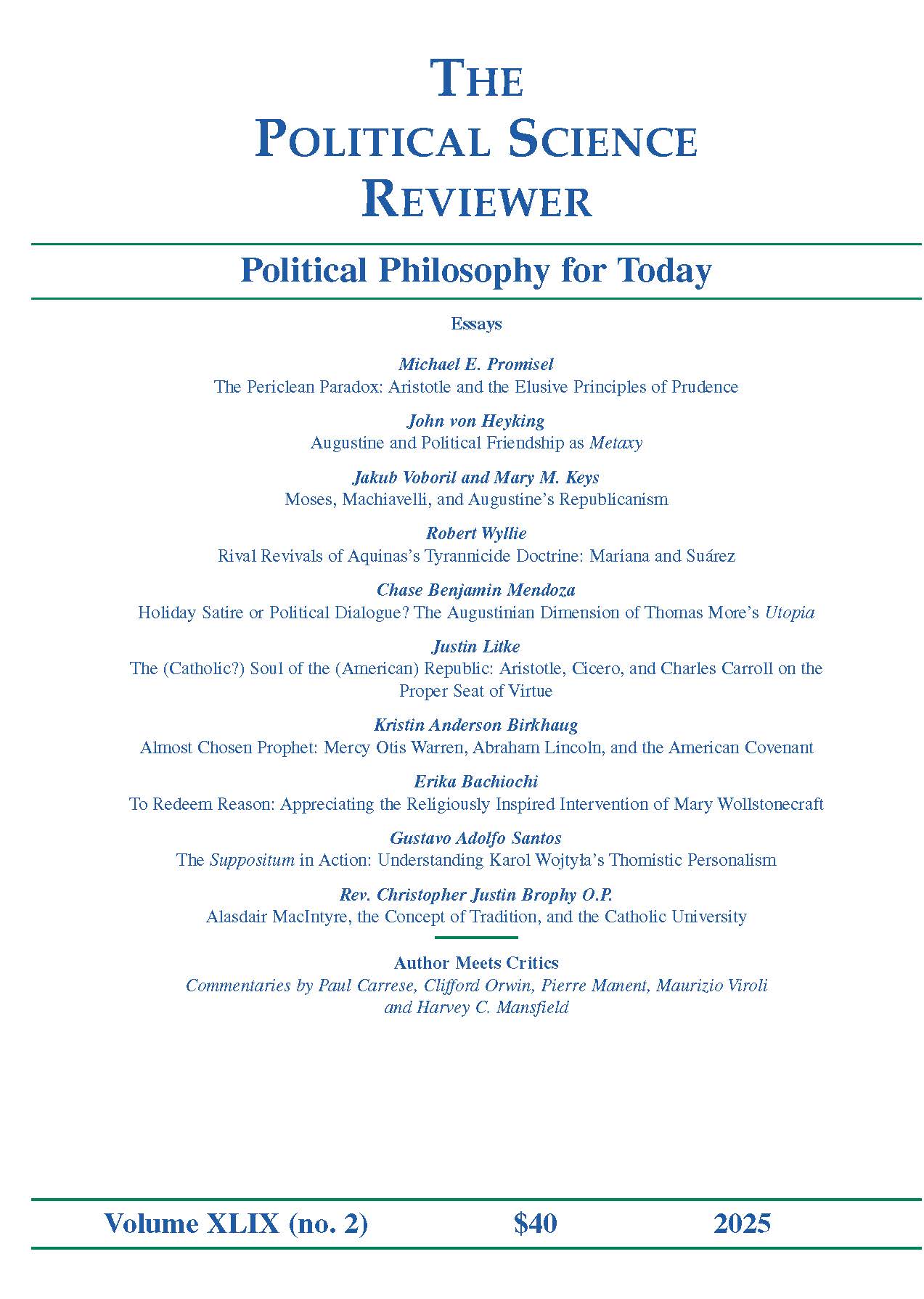
Augustine and Political Friendship as Metaxy. (2026). The Political Science Reviewer, 49(2), 33-60. https://politicalsciencereviewer.com/index.php/psr/article/view/879
Abstract
This article examines Augustine’s concept of political friendship as a counterpoint to liberalism’s reliance on self-interest to achieve political harmony, a premise increasingly doubted for failing to foster civic virtue. Using Eric Voegelin’s notion of metaxy—the “in-between” realm of human existence—it portrays Augustine’s commonwealth as a space where the city of God (love of God) and the earthly city (love of self) converge. Augustine defines a people as rational beings bound by common objects of love, contrasting with liberalism’s distorted Augustinian roots, evident in thinkers like Pascal and Locke. Political friendship, infused with Ciceronian ideas and eschatological depth, balances justice and power through prudent choices. This metaxic commonwealth, both divine and deficient, offers a unique ontological status. Amid liberalism’s crisis, Augustine’s vision—prioritizing justice over power and likening community to a joyful, improvisational "jubilus"—presents a compelling alternative for nurturing political friendship in contemporary society.