

Keywords
Mercy Otis Warren
American Founding
Civil War
American political thought
collective memory
Old Testament
political rhetoric
civil religion
How to Cite
Abstract
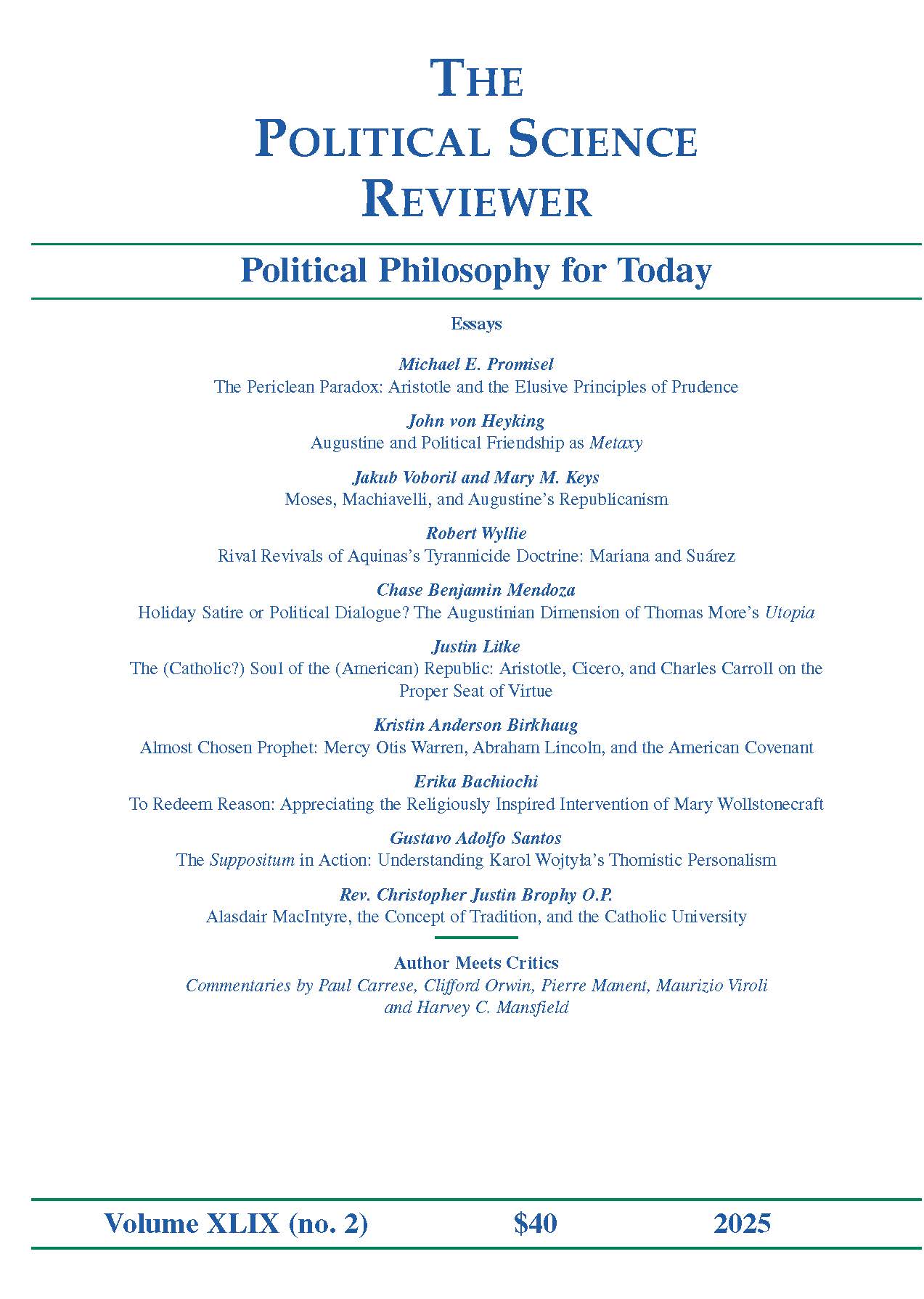
This essay examines the role of collective memory in the political theologies of two important American thinkers: Mercy Otis Warren and Abraham Lincoln. Warren, a founding-era Anti-Federalist, wrote one of the first authoritative accounts of the American Revolution in an effort to preserve a collective memory of the Founding, which for her was intertwined with covenantal Christianity. Warren is an important forerunner to Lincoln, whose construction of the collective memory of the Founding (modeled on the ancient Hebrews) set the stage for understanding the present and future of American politics. The essay concludes with a comparison of Warren’s and Lincoln’s accounts of American collective memory and affirms the necessity of these memories in the establishment of civil religion for both thinkers.